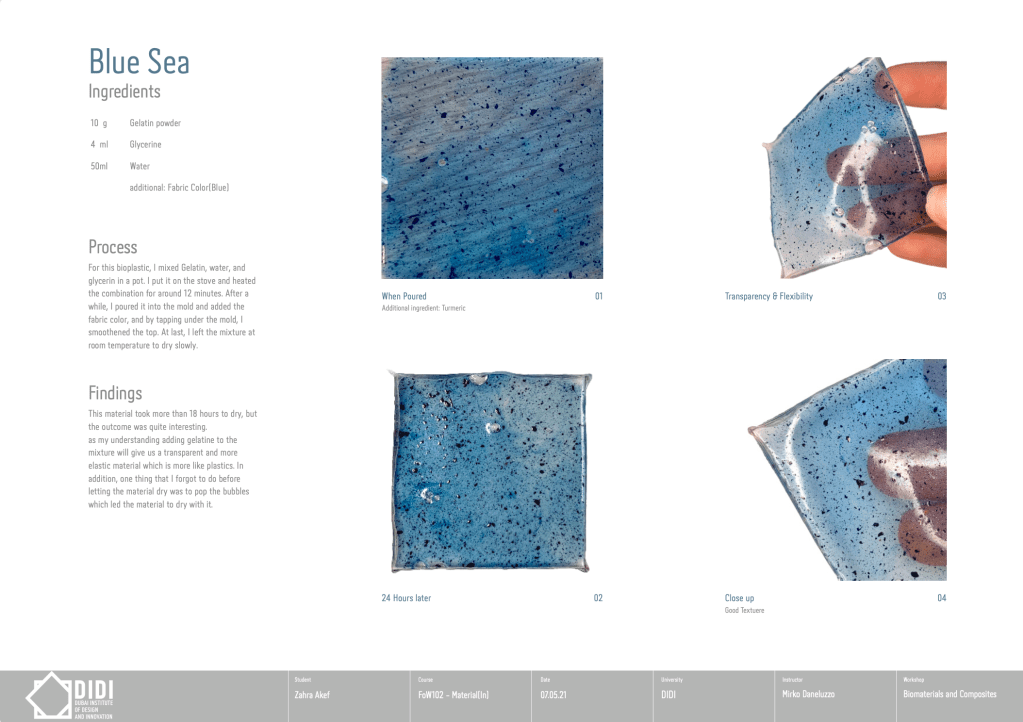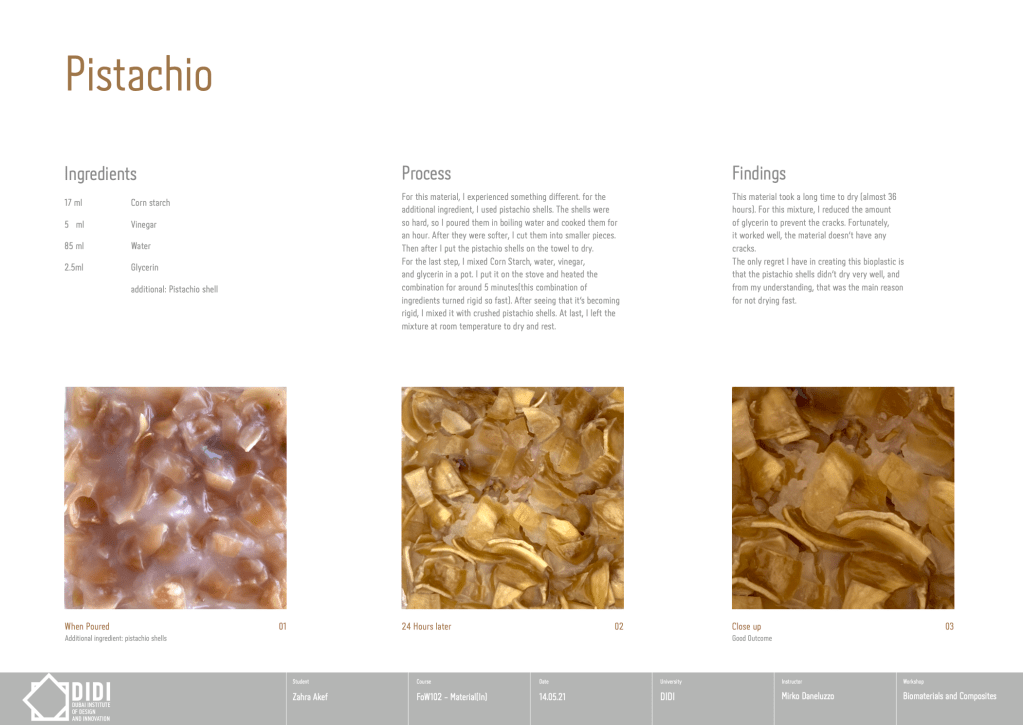
In this module, you will be introduced to some principles and methods of material design and creation, with a focus on bioplastics.
Starting with an observation of your kitchen leftovers, you will explore the potential transformation of organic waste into new innovative sustainable materials.
Driving inspiration from the open source and creative commons resources available online, you will experiment with existing recipes and evolve them with your own trials and documentation.
Process
Step 1: From organic waste to ingredient
- Take a look at your food waste. What can you salvage and turn into a material?
- Document this starting point by photographing the selected organic waste on white background; square format.
Step 2: Selection of Starting Recipe
- Research and select existing recipes with your chosen ingredient(s). Document them on your blog and reference the source. A good reference is the materiom.org website.
- Procure the remaining ingredients.
Step 3: Prepare your mould
- At the fab lab, use the vacuum forming machine to prepare your mould. You will find an MDF piece that you can use as a positive.
Step 4: Experiment, document, and evaluate
- Start experimenting by following the instructions of your recipe.
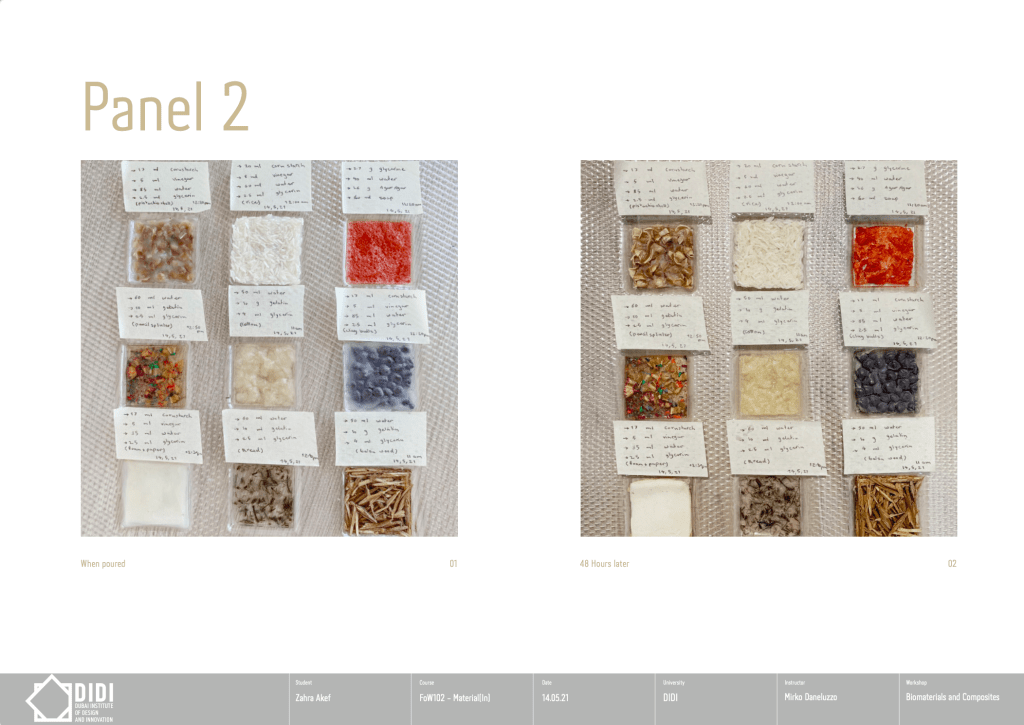
- Create a series of samples – each sample can represent a variation of the recipe: altering the ratios, adding ingredient(s), varying the methodology, etc.
- Keep track of the recipe for each trial and document it.
- Photograph the samples at different times (right after casting, 1 hour later, 5 hours later, 24 hours later, 3 days later) – photographs should be in square format, and cropped properly. Maintain the same point of view and lighting condition for all photographs. The main photographs should be top views. You can also add zoomed-in views and angled shots.
- Describe the characteristic of the results (smoothness, rigidity, transparency, etc.)
- What are the qualities of the material? What are its limitations?
- What variation can you create? Texture, density, color, rigidity, etc.
- Come up with recommendations to improve your trial.
Step 5: Take it further
- Post the process and outcome on your blog and on Moodle (as PDF as well as a packaged folder of your InDesign template containing all your images. Linked images should be of high resolution and already cropped in square format).
Congrats bio makers! Keep experimenting!